Zone-1 : Warm-Up
October 1st, 10 pm
The Catalonian coastline was pretty familiar to me by now, having been to Barcelona (and around) twice now, due to work trips. I had also planned to visit the office one of the days, although Calella (the actual venue of the event) was about an hour and a half away. No matter, there wasn’t much to do in the next 4 days.
‘I’ll get the suitcases, you check on the bike bag.’ Vrushali called out, heading off towards the baggage belt. I drew a nervous breath and looked for the Oversize Baggage belt; there had been two mishaps with my bike transportation till now, and both in trips to Europe. Once, in Menorca (an island off the coast of Spain), they had left my bike bag in our layover at Doha, and I had gotten it 3 days later. The second time, in Venice (for my Ironman 70.3 in Jesolo) one of the brake handles and the steering had gotten partially twisted. I had my toolkit and previous experience ready, but one never knew what to expect.
I got the bike bag (one problem out of the way) and met Vrushali near the exit. We caught a taxi for Calella, directly to our stay – Hostal Bonavista – since it was too late in the night for public transport, and dozed off – it had been a long 16 hours all the way from Bangalore.
October 3rd, 9 am
I remember the exact moment my nerves kicked in. I was doing an easy run along the Calella beach front, and I saw the Ironman tower, with a whole team assembling the finish line mini-stadium. It was happening, it was real – in 3 days time, an entire 2-year project would reach its finish line, literally.
We left for Blanes, a quaint, scenic town on the Costa Brava, soon after my run. It was right out of a Greek period drama, with rocky cliffs, azure waters, picturesque gardens and gazebos, and panoramic views of the Mediterranean coastline. As I stared at something right out of a postcard, I couldn’t help thinking about how patchy and under-confident my training had been. Sridhar sir had panicked a bit and ramped me up quite quickly in the last 2 weeks – hopefully that would be enough.
Truth be told, training was starting to get a bit repetitive (although that is the point) and joyless. I found myself looking forward to scenic trail runs (which I got plenty of during my stay in England) and aimless wandering around on the bike, whether in nature or for sightseeing around a city. Training for this Ironman, however, entailed doing consistent laps on a flat course, and keeping an eye on power, heart rate and duration; there wasn’t much room for aesthetics or exploration there. Perhaps I just loved doing scenic trails and races, and just powered on through the boring, mechanical training.
As I sat on the bus back to Calella, I realized this was really not the time to be questioning triathlons – time to shelve these thoughts, and get my game face on.
October 4th, 8 am
I wore my cycling shorts and put on my wetsuit over it, zipping it up as I walked on the early morning beach of Calella, near the swim start. It was supposed to be just a 15-minute conditioning swim, mainly to get used to swimming with the additional strain of the wetsuit on the shoulders. The cold would not be a problem, as I had just done a 4-member relay swim of the English Channel with Vrushali, less than 2 months ago; no wetsuit, colder water.
The clarity and serenity of the water blew me away – it was like swimming in a pool; albeit one with fishes and stingrays and jellyfish below you, coaxing you along like a snorkeling tour. The swim would be fantastic, for sure – save for the hundreds of thrashing and flailing triathletes ready to knock off your goggles and break your nose while trying to swim past you.
I had even done a short bike ride on the actual course, and it was nothing short of a luxury road trip, with panoramic views of the coastline and cities on the Costa Brava looming in the front, and the cool Mediterranean air blowing through the sunlit clouds on an orange sky. Sure, you were straining your shoulders and neck trying to stay in the aerodynamic position, with the seat putting a mild strain on your valuables that got excruciating over hours and hours – with a side effect of squeezing your bladder ever so slightly, which made you feel like you would have to pee in some time.
Triathlons were weird – we put our bodies through the cruelest of punishments, in the most surreal places.
October 5th, 1 pm
Drop off your bike and transition bags by noon, put your feet up and relax, I remembered Sridhar sir’s words. This was standard procedure for all triathlons, and it had become muscle memory by now, but my nerves were making me triple-check everything. Tyre pressure, check. Saddle bag and puncture kit, check. The TT bar bottle and the other bottles would be filled with water and electrolytes, and put in their holders on the morning of the race, just before the warm-up.
Next were the transition bags. T1 (swim to bike) – towel, t-shirt, helmet, cleats, socks, a gel, a water bottle, some dates. Check, check and check. T2 (bike to run) – running shoes, socks, shorts with gels. Easy.
The briefing had been straight-forward as well, with no last minute changes to the routes or the rules. It was all like clockwork, and when the gun sounded, my muscle memory would take over. There was no need to be nervous.
If only that’s how nerves worked – all kinds of hypothetical scenarios popped up in my head, and I resorted to drowning myself in carbs (mostly paella, patatas bravas and pasta) to distract myself. The more I loaded complex carbs and electrolytes before the race, the less I would need to rely on nutrition during it.
We went back to our stay – Hostal Bonavista, about half a mile from the swim start – at about 7 pm, and I settled into bed. I would wake up at 5 am, have breakfast at 6 am (which they so generously agreed to adjust) and leave by 6:30. The plan was already laid, I just had to follow it.
Vrushali looked at me. ‘How are you feeling?’
I glared at her, and she laughed. ‘How are you feeling’ is the one question that no one should ask anyone before or during any endurance race, as I had learnt while crewing for Vrushali in her English Channel solo attempt.
Because the answer never mattered.
Zone-2 : Easy
October 6th, 6 am
I was down in the dining hall, chewing my Spanish omelet vigorously like a cow, making sure to grind my morsel into a fine paste so there was no chance of a bowel movement. It was going to be a long day.
Vrushali was sipping some orange juice, going through the checklist aloud. ‘Water bottles, electrolyte bottles, wetsuit, cycling shorts, slippers, your bib belt – you need to fix the bib to the belt as soon as you get there.’
I nodded, still chewing vigorously. Put the bottles in their holders, bib on the belt, and some Snickers bars in both transition bags. Then try to relax and get your heart rate down, otherwise you’ll gas out in the swim. And try not to think about getting your heart rate down, because that’s the one thing that gets your heart rate up. Got it.
I was on my way, walking at a slower pace than usual, with the arms of my wetsuit dangling next to me. It was a chilly morning, so I wore a thick full-sleeve shirt, which I would remove just before zipping up the wetsuit. The Vaseline was already locked in, inside my cycling shorts, in all the important parts. I made sure to reapply some to my nape, where the zips and the velcro of the wetsuit met, making it a hotspot for chafing.
It was an electric atmosphere – tingling with quiet excitement, like the whispers from a crowd before a concert began. I could see determined triathletes all around me; we acknowledged each other with light nods, recognizing the hustle within us. That was enough to calm me down.
October 6th, 7:30 am
I wrapped up all my work in the transition area and walked to the swim start. The usually serene and empty beach was now filled with 3000 odd Lycra-clad triathletes, looking like a school of dolphins before a mass migration. I made my way to the start line for the 1 hour 10 minutes group – I estimated I was going to take at least 1 hour 20 minutes, but my coach always advised me to join a faster group, so I would be kicking people in their faces rather than getting kicked in my face.
The men and women of the pro category had already sped off – I couldn’t even imagine how fast they would be racing. They’d be back in their rooms, doing cooldown stretches, before I could finish even the bike leg. In fact, many of us would be finishing by nightfall.
I put the brakes on my various trains of thought and took a deep breath. The murmurs around me seemed to fade away, and the booming voice of the Master of Ceremonies came into focus, asking all of us to remember our Why. It triggered a mild sense of deja vu, as it had been the same host in my Ironman 70.3 in Venice-Jesolo, with the exact same song playing with his motivational narration – “Now We Are Free,” by Enya.
As the first few athletes were flagged off, the crowd started cheering and gathering around the fences, waving slogans and banners in various languages. Even the hosting party started giving shoutouts to the largest contingents – UK, Spain, Ireland, Belgium, Netherlands and many more; each with their theme songs as well! I was head-banging lightly to ‘Shipping Up To Boston’ as they welcomed Ireland, and I hoped that India would one day have a large enough contingent to be worth welcoming. I wondered what song they would play.
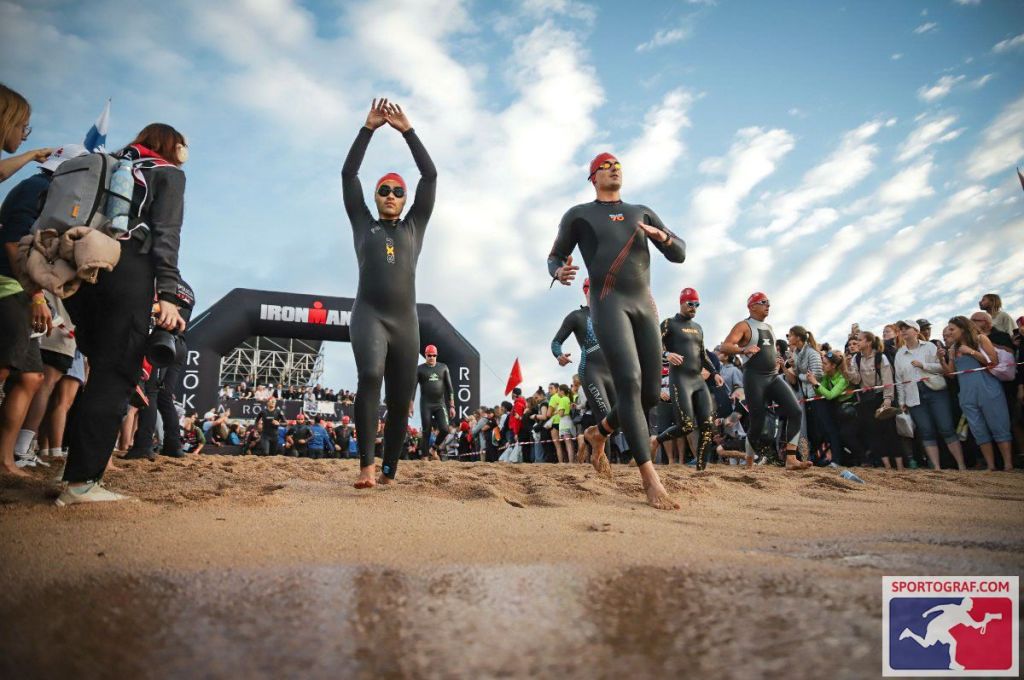
As that thought ended, I was at the starting line – they were letting 4 people go at a time, as per a standard rolling start. The buzzer sounded, and I ran into the water; I started playing my own song.
October 6th, 8:30 am
The best part about being a Qawwali singer? You could just sing a 40-minute piece twice, instead of having to loop a 3-minute pop hit 25 times. Although the latter was more useful during the final stretches.
‘Sochta hun ke woh kitne maasoom the, kya se kya ho gaye dekhte dekhte,’ I chuckled to myself as I dived into the cold water and started swimming freestyle. Muscle memory took over, but my stroke wasn’t very efficient yet, so I consciously hummed ’45 degree bend, easy recovery, controlled rotation,’ to the tune of the Qawwali. It wasn’t very catchy, but it did the trick. A few hands slapped my ears, and I felt a kick in my hip, but I had learnt to brush them off like a rugby player – the important thing was not to break the stroke.
I was drafting various swimmers for about 15 minutes, and then I found myself almost alone – finally, I could get into the mental zone. I suddenly noticed how calm the water was – there was a school of beautiful Rainbow Wrasse right below me, shimmering pink and blue with the sparse sunlight filtering through the water. It was just another day for them.
Left, right, breathe. Oh, what I wouldn’t give to have gills right now. I would only need to look up to sight, once every 6-7 strokes or so. The buoys were well-placed, easy to spot even through slightly fogged-up glasses and regularly placed (every 200 meters, by my estimate).

I started doing some math to entertain myself (the Qawwali had faded into the background). The swim course was shaped like a flag on a pole – a few 100 meters into the water, then a right turn, then a long path parallel to the coast until the rocky cliffs and the lighthouse, then a left turn, a few 100 meters more, then another left turn, and all the way back to the first turn (with a few extra 100 meters ahead). Finally, another left turn and then straight back to the coast, ending up a little to the right from where we started. It was like a geometry problem – what combination of distances would bring the total up to 3.8 kms?
I was at the halfway point now, taking the left to go back towards the start. A marbled stingray zoomed past me, casually hovering above the sandy bottom at a relaxed pace faster than my sprint. I felt instantly humbled, yet motivated; it was pure willpower that drove humans into the farthest reaches from our comfort zones. I felt faster in the second half – probably the tides were with us now. Ocean swimming had so many more variables than in a pool.
As I powered towards the finish line, all the swimmers started converging, and I felt the bittersweet slaps yet again – sweet because it meant I had stayed on course, and hadn’t been too slow; bitter because, well, they were slaps in the face.
The sandy bottom rose up to meet me, and I launched myself onto the shore, my legs taking over. The sound of cheering instantly enveloped me, and I unzipped my wetsuit while looking for Vrushali in the crowd, legs wobbling towards the transition area. I was sure she was watching from somewhere, her voice drowned out by the crowd.
With laser focus, I peeled off the wetsuit, wiped myself dry, re-strapped my timing chip, wore my socks, cleats and the t-shirt with the bib belt, gulped a gel and some water, and stuffed two dates in my mouth, chewing quickly while doing a penguin-waddle towards the bike racks. It was tough to walk in cleats, but it was better than getting a tiny pebble stuck under my foot, which would get pushed right up to my knee by the time the race was over.
I grabbed my bike and jogged to the starting point, with several other athletes both behind and in front of me. I felt fresh and light as I mounted my bike (having done all my pissing in the Mediterranean Sea), and started the longest and loneliest leg of the Ironman. Barcelona, here I come.
Zone-3 : Aerobic
October 6th, 10:00 am
The first 3 kms were slow, filled with 90-degree turns and speed-breakers, since we were just making our way to the highway. This was where most of the crowd was standing, holding signs like ‘Pedal like you’re on the run’ and ‘Lift to Barcelona, please?’ among others. I grinned – you really couldn’t do triathlons without the ability to laugh at yourself for doing them.

The highway emerged, and I went down into the aero-position, instantly feeling a slight pressure on my groin. In the last few weeks, Ritwik from Velo Studio had angled the seat slightly downwards, and tilted the aero-bars slightly upwards to ease the pressure. It had worked wonders; whatever pain I felt after only 2 hours of riding would now hopefully come after 5 hours.
I took a sip from the straw of the TT bar bottle, just to test it out. Last time, in the Ironman 70.3 in Jesolo, the bottle had fallen off completely, and the rubber strap holding it had disappeared somehow. I couldn’t afford such a mishap in a 180-kilometer ride.
We exited the city area of Calella, and the beautiful cliffside roads began, glowing yellow-orange with the early morning sun, making the blue waters sparkle to my left. I wish I could have mounted a GoPro, but no device except a bike computer was allowed. It was better to savor the view this way, knowing I would only have my memories later to relive it; it made me take in everything more intensely.
Of course, this feeling would last about an hour; then my body would heat up, the sun would get scorching, and the crosswinds would pick up – I wouldn’t be in a state of mind to appreciate nature too much.
‘Just don’t crash, and you’ll be fine. Your run is strong, just finish the bike without dying,’ Vrushali’s words came back to me. I remembered Anuj (my friend and another member in our 4-member English Channel relay) telling me about the accident he had witnessed when he had done this same race last year. There was one small stretch of narrow roads, where it was important not to get carried away and to turn carefully, lest you drifted into the incoming lane and crashed into the returning cyclists.
I chuckled grimly. Each leg of the Ironman had its own dangers. Historically, most people actually died during the swim, which made sense – open water swimming with thousands of people crashing into each other was a recipe for disaster; it was actually very easy to panic and start inhaling water, even for seasoned swimmers. The bike leg had the most variety of possible problems – punctures, crashes, equipment falling off, needing to stop to pee or take a dump, running out of water, electrolytes or carbs, getting lost… you name it. And the run leg – the most brutal on the body; that was where all the fatigue and slow drain took its toll and manifested itself in all sorts of niggles, cramps, chafing, palpitations, giddiness – even injuries sometimes.
I shook my head, brushing off these thoughts, focusing on the beautiful route and my feeding plan. It was simple really – a sip of electrolytes every 10 minutes, and a gel with water every 45 minutes. Every third gel would be caffeinated, and I would switch out one of the electrolyte sips with just water, when my mouth started drying out. Salt capsules every 2 hours, to retain water in the body. I would also take a break from the aero position on every uphill stretch, and flex my back muscles to prevent them from stiffening. Simple.
As we headed towards Badalona (which was the eastern edge of Barcelona), the road shifted slightly away from the coast and into the city. The route had changed from last year; they had added a long uphill stretch somewhere around Mataro (midway to Badalona from Calella) and taken us further into the Barcelona city area to round it off to 180 kms – which meant there would be only two loops. The energy was still very high, by-standers and pedestrians had come out to cheer the athletes. It was very encouraging to hear shouts of ‘Vamos, vamos!’ every 10 seconds, although it was less encouraging to see them sipping beers and lemonade under the cool shade of an umbrella. Well, there would be plenty of time later for that.
The first half of the first loop had ended. I took a U-turn and faced the sun directly, heading back to Calella. So far, so good.
October 6th, 12:30 pm
The clouds had come in, as if sent by the organizers to shield us from the afternoon sun. It was a much needed respite, as I had not carried too much water, expecting colder temperatures and less exertion (this was one of the flattest Ironman bike courses). I could see the beaches of Calella in the distance, which meant I was close to the end of the first loop. To my left, the pro athletes whizzed past me, most definitely completing their second loop and moving on to the marathon. How were they overtaking me so fast while going uphill?
I shrugged those thoughts aside. Run your own race, your own pace. Soon, the roundabout came up, and to my surprise, I spotted Vrushali in the crowd, shouting ‘Go Danish, Go!’ I smiled from ear to ear, and circled around, starting the second loop. She had told me that she would disappear after the swim, maybe explore Calella or go further east on the Costa Brava. I was grateful to see her, and I could see the relief on her face too, as I had survived the first loop. 3 hours and 8 minutes – not bad, I had estimated a total time of 7 hours minimum, as cycling was the weakest for me, but this was much faster than expected. Everything was going great; all I had to do was maintain it.
Halfway to Badalona, on the first big uphill, the relentless pressure on my groin started showing its effects. Time for evasive maneuvers – I sat slightly ahead, on the nose of the seat. This would create more pressure, but in a different place. I would have to keep alternating between those two positions, so as to spread the discomfort. I increased my cadence as well, trying to start some burn in my legs; hopefully, two different pains would confuse the brain and I would feel neither of them.
In 10 minutes, my entire lower body was on fire, and I started brainstorming other solutions. I started trying various positions on the seat, sometimes putting my left cheek on it, sometimes my right, sometimes sitting all the way back, sometimes all the way front. To another cyclist, it would look like I was giving my bike a lap dance.

Come on, just survive, one last stretch, distract yourself, don’t worry about the speed, the aero position, just keep rotating positions. I renewed my resolve as I took the U-turn from Badalona back towards Calella, and fought the pain. I wasn’t worried too much, I knew that as soon as I got off the bike, these problems would be behind me. I just had to finish the ride.
On the way, I could see multiple cyclists stopping for refreshments, toilet breaks, or simply to rest. I felt slightly better – no matter how long I took, I had told myself that if I never needed to stop or rest, I had done a good job. So far, I had kept that promise.
October 6th, 3:30 pm
‘Tumhe dillagi bhul jaani padegi, muhabbat ki raahon mein aakar toh dekho…’ It was one of my favorite Qawwalis, and the crux of it was pretty poignant. ‘You’ll have to forget about infatuation, once you start the journey of love…’ it was a pretty accurate description of any sort of passion, be it for a person, an art form or a sport. You started off badly, not knowing much – but as you grew stronger and wiser, you started getting better very rapidly, which boosted your confidence and made you fall in love with the process.
But it wasn’t really love. Love was when the steep growth started tapering off, and every additional unit of time and effort yielded lesser and lesser gains – but you continued, because you were now invested in even the suffering, not just the destination. You were invested in the person you would become through it all, not just in the enjoyment during it. You would not quit as soon as the mental and physical discomfort began; you would not lose interest as soon as the aerobic rush ended.
As the pain in my nether region reached unbearable levels, I dug deeper into my willpower, using these lyrics as a shovel. Remember your Why, he had announced in the beginning. I dug for the answer.
The roundabout came up again, bringing with it a wave of relief that somehow spiked the pain in my groin, as if saying, all right, we’re done, get off now. I grunted and got up from the aero position for some relief. The body could be very stupid sometimes; this was exactly like holding in a shit and driving back home at full speed, feeling confident that you would hold it in until you got to your bathroom – and then as soon as you saw your building, your bowels would let loose.
Just half an hour more, I smiled, and relaxed. Time to taper down, and give my legs a chance to recover for the run. Even through the pain, an internal cheer came through. I had survived the bike leg; I had survived the longest ride of my life, and emerged unscathed – in less than 6.5 hours! There was a chance I could finish the Ironman under 13 hours, a target I had considered unrealistic for my first one.
I navigated the last 3 kms carefully, cheered on by crowds and encouraging placards. As I turned on to the Calella beachfront, I saw a volunteer holding the flag signaling the dismount. I unlocked my cleats and got off, my legs immediately turning to jelly. As I celebrated internally, a small pessimistic thought creeped through – I had never run a full marathon; and now I had to run it on legs that had become tentacles.
In the distance, I saw a kid holding up a placard – ‘Pain is temporary. Ironman is forever.’ He was right – this marathon would definitely feel like forever.
Zone-4 : Threshold
October 6th, 4:40 pm
After taking off my cleats, wearing my running shoes, and rotating the bib belt to now face the front, I headed straight to the porta-potty for a piss. Enough salt capsules and electrolytes had ensured no pee breaks on the bike ride, but once the pressure had been taken off the groin, the urge to pee had returned. No matter, a slightly longer transition time was better than a much longer and more uncomfortable run.
Once that business was resolved, I ran out to the running track, accompanied by a few dozen athletes – this was my comfort zone, and yet, would be the biggest challenge of my life. 3 loops of 14k each, going along the coastline, briefly into the town of Calella and back out towards the finish-line arena, where we would get to see the athletes that were finishing, with each loop. I could see many of the age-group elites finishing already, in a little over 8 hours. I could hear the announcement – the athlete’s name, their country, followed by those precious words – You. Are. An. Ironman.
I started running, and suddenly, a sharp pain went up from under my foot. Oh damn. This was new. I stopped quickly for a minute, removing my socks and checking for small pebbles – nothing. I noticed a small black spot on the underside of my right foot – whatever it was had gone deep inside during the bike ride. There was nothing to do but keep running.
I adjusted my foot striking a bit, putting the heel first, twisting my ankle slightly outwards, so only the outside of my foot would strike the ground. Eventually, those sharp pangs started getting duller; I realized that the object was getting pushed deeper inside the foot, which was ironically reducing the pain upon impact. Oh well, that would be a problem for Ironman Danish, not for me.
This was the most interactive part of the race; we were running through the various beachside bars and pubs of Calella. People were dancing, twirling banners and ribbons, playing songs loudly, cheering us on.
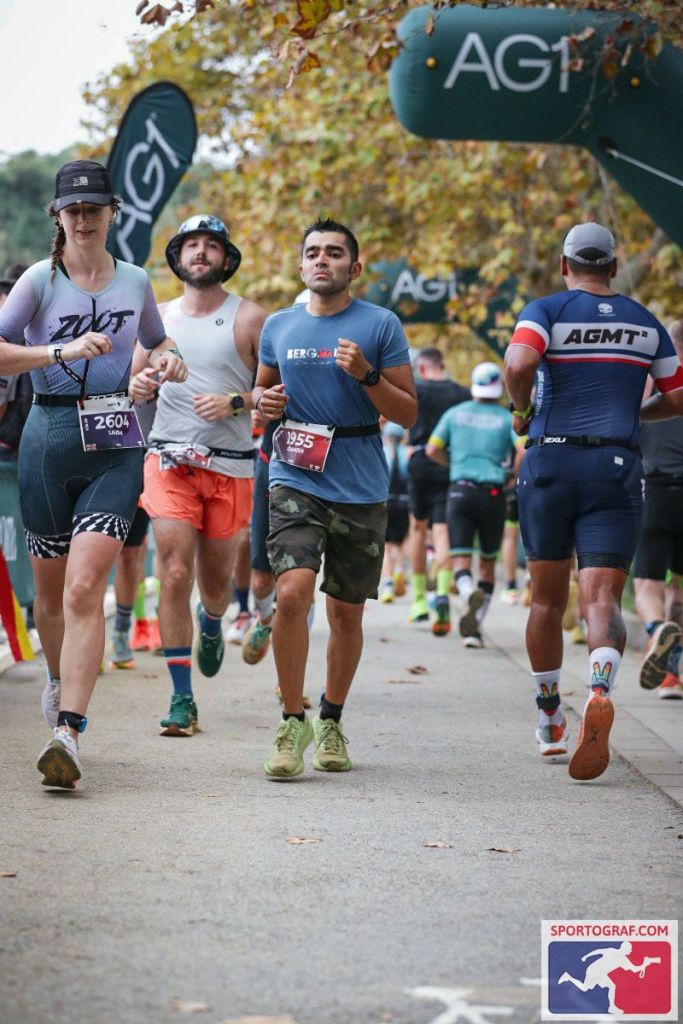
‘Pain is just the French word for bread.’
‘Smile – remember, you paid to do this.’
I chuckled and soldiered on, maintaining a pace of 6 minutes per kilometer. Humor would get you through the most difficult circumstances.
October 6th, 6 pm
We had just turned away from the beach, into a major street in Calella, lined with cafes and bars and people standing along the barricades, cheering us on. For me, the most heartwarming moments were when people were reading athlete’s names from their bibs and cheering for them personally – it was one of the kindest gestures you could show a stranger.
In the middle of the street, I spotted Vrushali, cheering me on. ‘Pel rahe ho, ladke!’ I smiled and pumped my fist in the air. My pace was below 6 minutes a kilometer, and I was going pretty strong. As I took a U-turn and then headed back to the underpass for a right turn onto the beachfront (yeah the run route was slightly complicated), I started envisioning myself crossing the finish line, hopefully not more than 4 hours from now. A new wave of ecstatic gratitude filled me as I realized I was going to be an Ironman for sure, the only question was when.
Soon, I was back at the arena, starting the second loop, as I saw more and more athletes crossing the finish line in the lane parallel to me. There was something surreal and humbling about seeing thousands of people achieving something one after the other, that less than 0.01% of humans had done. It was then that I realized the difference between self-esteem and arrogance; the former was a feeling of having grown and achieved something that was previously just a fantasy for you – the latter was the feeling that this made you a better person than most other people. Everyone was doing an Ironman of their own – maybe it was a different distance, different intensity, different genre, didn’t matter. As long as you climbed a mountain bigger than yourself, you were an Ironman.
October 6th, 8 pm
The sun had disappeared long ago, and we were left with the dark blue haze glowing lightly above us, competing with the gradually appearing streetlights; the heralds of the night. I had hoped to see a sunset along the beach, but there were bigger hopes and dreams waiting for me.
The Qawwalis had given way to pop songs now. It felt weird going from ‘Mere rashq-e-kamar, tune pehli nazar…’ to ‘If you like Pina Colada…’ but shorter songs worked better as milestones during the run.
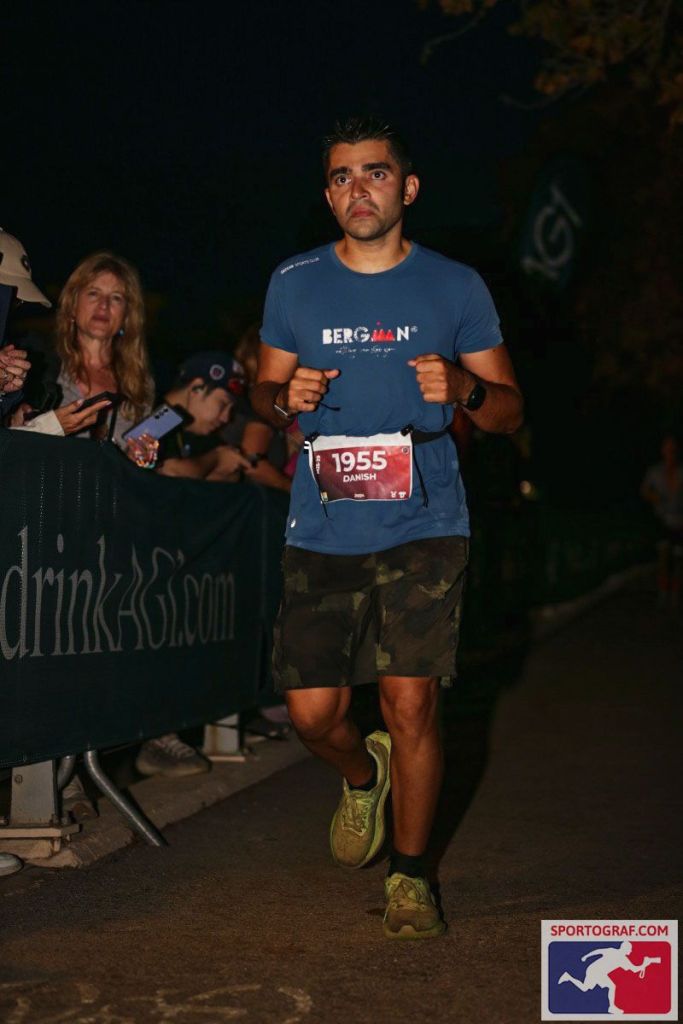
The pros and elites were done long ago – I had seen them checking out their bikes and their bags and heading home, during my second loop. Now was the time for the amateurs to shine; the ones in the 11-16 hour category. Some of us were stronger cyclists, jogging or power-walking through the marathon at a very relaxed pace. Some of us were stronger runners, taking our time on the bike, and then zipping past everyone during the run. I was in the latter category. Even in the Ironman 70.3 in Jesolo, I’m sure I had overtaken more than half the people who had overtaken me during the bike course.
This time too, it was the same – and honestly, it was a good feeling. Finishing strong always brought me the assurance that I had executed the race well, rather than slowing down and slowly tapering off all through the marathon. But the spring in my step was getting weaker, and my pace was dropping slightly. I had just crossed the 30-kilometer mark, and my pace was down to 6.5 minutes per kilometer. My inexperience in running marathons was showing.
‘Come on Danish, one last loop!’ Vrushali shouted, now clearly audible in the street. The crowd had thinned out to almost half the original volume, as had the decibel level of the cheers. I pumped my fist in the air, although I wasn’t feeling as strong as in the beginning.
I had started eating bananas and drinking the electrolytes provided in the nutrition tents. My gels were now too sweet for my liking – after 8 of them, my tongue now felt like jam. My nutrition plan was thrown out the window; I was just playing it by ear now.
9 more kilometers, I thought, as my pace came down to 7 minutes. You don’t need to be fast, just keep going, 7 minutes is a good pace. This was uncharted territory now – I could be conservative and slow down as my legs slowly give up, or maybe I could power through and risk injury close to the finish line. Time to roll the dice.
Athletes can run, walk or crawl to the finish line, I remembered this line from the Ironman race guide, which had made both me and Vrushali laugh uncontrollably. Now, I was more thankful than amused.
October 6th, 9 pm
The last 4 kilometers were steady, but really tough on the legs. I had held on for more than an hour, occasionally getting faster and getting back the spring in my legs, but I was approaching the metaphorical wall – the point of no return.
Half of the athletes around me were walking now, and I was dodging them left and right as I kept jogging slowly, keeping a steady pace of about 7:15. There was no point in stopping now – I had enough nutrition and electrolytes, any more would just create dead weight. Also, I feared that if I stopped, my legs would probably never start again.
Most people perform to their talent. They work hard, sure, they tolerate a certain level of discomfort, but there comes a point that they’re not able to cross. That’s the threshold for greatness. Once you cross the limit of your talent, and you allow yourself to feel weak and inadequate, that’s when you’re not just gonna improve – you’re gonna evolve.
I had forgotten who had said this, but it seemed like my mind had conjured it back in this time of need. This is what I had been digging for, ever since the second loop of the bike leg. This was the answer.
I gritted my teeth and sped up, regaining the spring in my step. The banner marking kilometer 41 came up, and I powered on, fueled by sheer resolve. My legs were aching horribly, but I was determined to finish strong.

‘Danish, grab the flag, I asked them, they’ve allowed it.’ Vrushali ran to me, handing me the Indian flag. I grabbed it, without breaking my stride. As soon as I unfurled it behind me, an unearthly frenzy took over me. Just a few 100 meters away, the arena awaited, a cacophony of cheers and announcements, all the chaos resolving into a beautiful final melody. I had really done it. Just a 100 meters away, I was an Ironman.
‘This is 10% luck, 20% skill, 15% concentrated power of will.
5% pleasure, 50% pain, and a 100% reason to remember the name.’
I rang the beginner bell to indicate that this was my first Ironman, and sprinted to the finish line with my arms above me, my signature move. Man, the percentages in the song really were spot on.
Zone-5 : Euphoria
October 6th, 9:25:40 pm
‘Danish Abdi, from India. You’re an Ironman!’
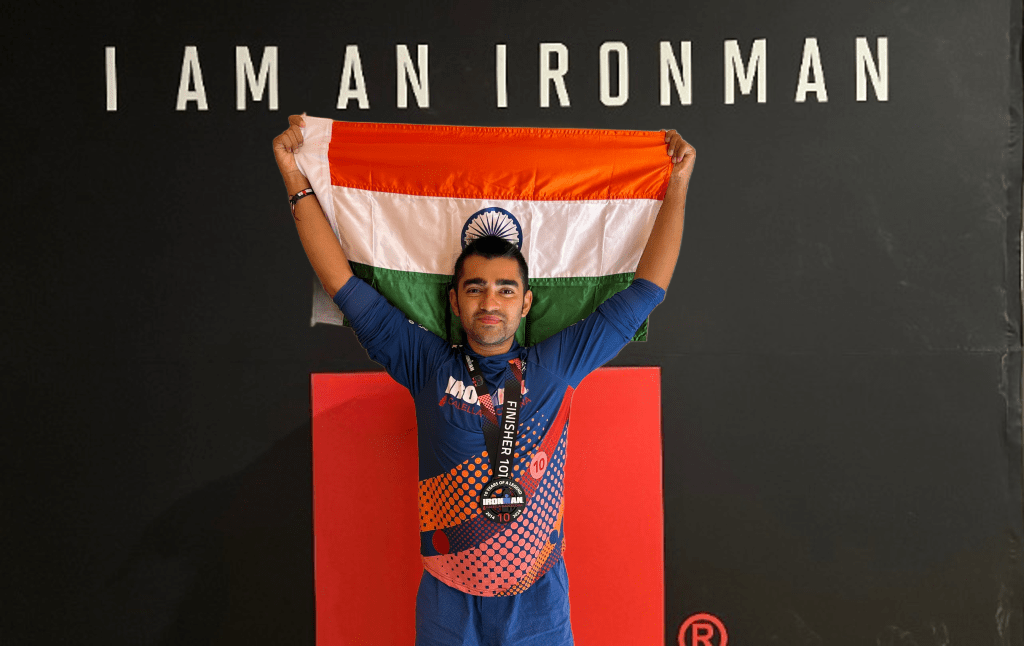
I was in a daze, still holding up the flag as I crossed the finish line. Once I realized it was over, I put down my arms and stopped running. Someone put a medal on me, and I shook hands with them. They directed me to the recovery tent, and I walked aimlessly, letting my legs take me wherever they were going. Was it done?
I went to the finish line bags, where I had kept a hoodie and shorts to wear after the event. Still reeling from the realization, I changed my clothes, put in the flag and my shoes on autopilot, and walked into the recovery tent. There was a small line for getting my timings engraved behind my medal, which I had booked previously. I joined it.
‘Congrats man,’ an athlete who had just arrived after me said, shaking my hand. ‘Thanks. Oh, you too,’ I replied awkwardly. A woman at the counter took my medal, smiling at me slightly. ‘Congrats,’ she said. Within a minute, they stamped my medal and gave it back to me. 12:55:40.
‘Next,’ she called out, and the assembly line continued. Just another day, just another task.
There was only pasta, with two different choices for sauces – tomato and pesto. ‘Carbs,’ I said lightly, and grabbed two bowls, filling them with pasta and one sauce in each. ‘Electrolytes,’ I mumbled and grabbed two oranges. ‘Water,’ I murmured and grabbed a glass of water.
Fork and spoon. Chair, table, sit. Open mouth, inhale food, sip water. Hunger. Pure, unadulterated, starving-Neanderthal-hunting-a-mammoth-on-the-edge-of-death-in-the-ice-age hunger. Two more bowls of pasta. Maybe it would be more efficient to grab four bowls. Would they allow me to just sit next to the counter?
My hunger was quickly satiated – well, it wasn’t surprising, endurance races started a mechanism of fat burning that would keep one’s body going. Like a fireplace, even after the wood had turned to ash, the residual heat would go on for hours. My body was doing the same, unleashing tons of calories even though I had stopped moving. I would consciously have to eat a lot of protein and drink fluids to speed up my recovery.
‘Hey man,’ I spotted someone with an Indian flag on their bib. ‘Congrats.’
I shook his hand. ‘Sachin Bansal, from Delhi. Congrats, glad to see a fellow Indian here.’
I nodded. ‘Danish Abdi, from Bangalore. I was waiting to spot an Indian on the run course, but didn’t see anyone.’
It turned out at least 6 Indians had participated – there had even been an Olympics-style flag parade on the 5th, to commemorate the 10th anniversary of Ironman Calella-Barcelona. I had mistakenly thought it was a Thanksgiving-style parade put on by the residents of Calella to celebrate the event, and thus hadn’t gone.
I took a picture with Sachin in front of a large Ironman banner, and chatted with him for a while. Knowing someone had traveled a similar distance, and done the same race as you (and was walking awkwardly with dead legs just like you), always made you feel better. You weren’t a crazy person; you had simply done something crazy.
October 6th, 10:30 pm
‘Let me just collect my finish line bag, and I’ll come out,’ I called out to Vrushali, who was waiting behind the barricade. I bent down to pick up my bag, and my legs immediately collapsed.
‘Yeah, I’m feeling the same way,’ someone behind me laughed, and I laughed with him. I pushed myself off the floor with my hands, and awkwardly swung the bag around my back. ‘Never doing that again, that’s for sure.’
‘Definitely,’ I echoed the sentiment. ‘As one sign said – remember, you paid to do this.’
He chuckled at that. ‘Where are you from?’
‘India.’
‘Oh damn, that’s really far! I’m Steve, from England. For me it was just a 2-hour flight – I don’t know how you managed it.’ He nodded appreciatively. ‘Great motivation, man.’
‘Yeah, we only have an Ironman 70.3 in Goa. The European climate is best for such races, so I ended up choosing this one – scenic enough to be fun, and easy enough to not die while doing it.’
‘Don’t be so sure, wait till tomorrow.’ He chuckled. ‘Congrats man, wish you a speedy recovery.’
‘Congrats to you too, take care.’ I waved at him and hobbled towards the exit.
‘Danish!’ He suddenly shouted. ‘You. Are. An Ironman!’
I laughed out loud. ‘Steve! You. Are. An Ironman!’
He gave one last cheer and walked away, with a little more strength in his legs. I knew for sure, some strength had returned in mine.
October 6th, 11:30 pm
I had checked out my bike and my two transition bags. The hotel wasn’t that far – about 800 meters – so we walked slowly. I realized that my legs were fine, but there was some pretty brutal chafing in the glutes area; probably from all the lap dancing I had been doing on the second loop of the bike course. Of course, there was also the thorn in my right foot, which had started hurting again while walking – but all these problems were washed away in the euphoria of having completed a 2-year long project.
‘So, you feeling strong enough to climb Montserrat?’ Vrushali grinned at me. I had previously joked that I had always recovered within a day after every half-iron distance, so I could probably climb Montserrat two days after the Ironman.
‘Can I tell you tomorrow?’ I chuckled.
Vrushali laughed and hit me on my arm. ‘You’re not moving for two days minimum – you just need an opportunity to flex, don’t you?’
I smiled and looked down. Sridhar sir had always said that recovery was the hidden fourth leg of the Ironman – and the longest one.
‘You killed it, Kyoti.‘ Vrushali grabbed my arm. ‘Less than 13 hours, sprinting at the finish line, no resting or walking – what a show!’
I beamed at her, the enormity of the achievement hitting me slowly. 2 years ago, I had thought of the Ironman as a distant fantasy, something only genetic phenoms or lifelong athletes could do, after years and years of training for it. 2 years later, here I was, medal on my chest, war wounds on my legs, iron in my veins, and a fantasy in my memories.
“I don’t know where I wanna be,
I’m not swimming to get to the land,
Or running to get to the sea,
I’m learning so I can understand,
And forgetting so I can be free,
So no matter where I wanna be,
As long as I’m moving, I’m me.”


 Our Life In Miles
Leave a reply to Mayank Thakur Cancel reply